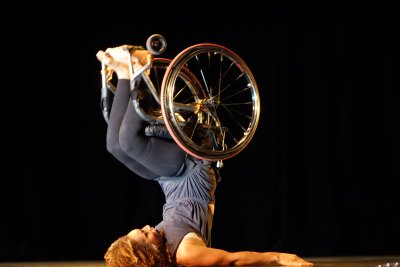
I understand my definition does not meet most people’s definition of disability.
Emmaly Wiederholt, Stance on Dance, 16 February 2017 source ↗
The question
What important truth do very few people agree with you on?Originally asked
Peter Thiel, to job candidates, Zero to One, chapter 1, 2014
Peter Thiel, Zero to One, chapter 1, where it is introduced as his job-interview question. Thiel supplies his own standard: a good answer takes the form "most people believe x, but the truth is the opposite of x."
You answer as yourself. Nobody on FLAPSS answers as anybody else.
I understand my definition does not meet most people’s definition of disability.
Emmaly Wiederholt, Stance on Dance, 16 February 2017 source ↗
I'd argue that while no doubt mistakes have been made, including by us and KKR, many have misunderstood (or greatly simplified) the model. They have overlooked how value is created -- and for whom.
And I say, “Every single dollar that was spent on the space program, went into the pockets of the individuals who worked on it: the contractors, the subcontractors, the vendors. It went to feed their children, put clothes on their back, send them to school.…If we are going to be the leaders of the world, and we are going to worry about trade balance, if we are going to worry about military systems, or solving the problems of the environment, we are going to have to continue to spend money on research, medical research as well.
I think they have no duty. But we do have the opportunity, not to change the world, but to make people think differently.
But a running theme has been how many men have said something along the lines of, “Wow, I was so surprised I loved your book, because I’m a man.” These men mean no harm—I don’t take those comments personally—and yet the fact that they were surprised that they loved a book by and about a woman is an indication of the sexism women writers are up against every time they write.
When stuck, go to someone else’s show—in a different discipline
I do not consider Kinetic Light’s work radical. It is not radical to imagine a disabled audience as primary and to make the work accessible to that audience. It is not radical to situate a work within disability history, culture, and traditions. Non-disabled artists do that all the time.
I have reached the point in my career where I can choose my collaborators and the artists I want to create with. My Kinetic Light partners, Laurel Lawson and Michael Maag, are my dream collaborators, and Kinetic Light is the place, time, and people with whom I am making some of the most creative and meaningful work of my life.
Do it. It is the hardest thing you will ever do and it will bring you immense joy. You won’t be alone, there is an entire community here for you.
What I think you’re asking is, “Does it change the movements on stage if you have people come and watch it?” I would say, yes it can, but not always. Not every comment will lead me to go back to the stage and change something… but it can. Often you don’t know how stuff is landing, so it can be helpful to get a viewer’s perspective. Since I’m in the piece, I’ll never be able to see what it looks like from the outside.
I’m reading an odd collection of books that should not go together, but of course they do. Georgina Kleege: What Blindness Brings To Art; Fred Moten: Black and Blur; Theri Pickens: Black Madness :: Mad Blackness.
Alan Dale, Ja’Tovia Gary, David Lynch, François Ozon, Alexander Armstrong, Ephraim Asili
Search the directory for somebody in particular.