Do it. It is the hardest thing you will ever do and it will bring you immense joy. You won’t be alone, there is an entire community here for you.
Sophie Griffiths, DIVA, 9 April 2020 source ↗
Do it. It is the hardest thing you will ever do and it will bring you immense joy. You won’t be alone, there is an entire community here for you.
Sophie Griffiths, DIVA, 9 April 2020 source ↗
And the most fulfilled, centered, grounded, happy people I know are people who made the choice to be part of an effort to actually make the world a better place. ... I would say, to me, the path of least regrets is to at least make a short-term commitment to say, “Let me work to make a real difference in the world.” The worst that could happen is you decide to move into something else later, but you’ll always take with you what you’ve given and what you’ve gained through that experience.
I’d tell them, “If you believe in something, go for it, but know that when you go for it there’s a price to be paid. Be ready to pay that price and you can contribute to the welfare of society, and society will acknowledge you and respect you for it. And don’t be afraid. Don’t be afraid.”
The most important piece of advice that I could give them is to take advantage of the tremendous reservoir of knowledge that’s out there today. Spend some time learning how the world has evolved. There are a lot of good lessons in history, and other peoples’ experiences in the past, that could be exactly the solution to the problem you’re looking for.
So any student who wants to get into psychology, right now the students are like lemmings. They say, “Well, it’s popular to study brain science, I’ll do that.” Or, “It’s popular to do neural networks; I see 30,000 people doing it, it must be good.” And my advice is if a lot of people are doing it, don’t waste your time.
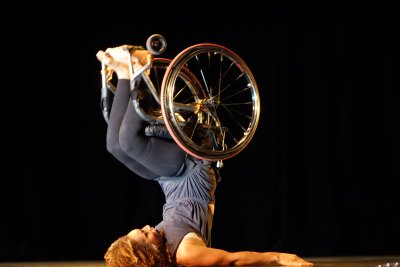
Obviously, it’s different for everyone. And actually there is a difference for each thing I do. But one way it happens is to just move. [ laughs ] I mean, obviously, you don’t just sort of randomly throw yourself around the room. You move with these ideas and sometimes I find that I’ve already got images in my head that I imagine my body in, or sometimes I have sequences in my head. I think a lot of time I’m listening to what comes next because sometimes the body will tell you that. Often I don’t document it too early in the process because sometimes if you forget stuff it’s worth knowing that the things that you forget maybe weren’t worth keeping. The things that have settled are the things that need to be kept because they seem most urgent. I don’t know. I mean, sometimes it’s about going to the studio and nothing happens for a long time and you just sit there and you’re not feeling it. That’s awful. It’s like when you’re writing and sometimes you go to the coffee shop and you’re like, “So, we’ll just see what happens.” And you end up on Facebook. I think the answer to this is… I really think the answer to this is I don’t know. [ laughs ]
I have reached the point in my career where I can choose my collaborators and the artists I want to create with. My Kinetic Light partners, Laurel Lawson and Michael Maag, are my dream collaborators, and Kinetic Light is the place, time, and people with whom I am making some of the most creative and meaningful work of my life.
What I think you’re asking is, “Does it change the movements on stage if you have people come and watch it?” I would say, yes it can, but not always. Not every comment will lead me to go back to the stage and change something… but it can. Often you don’t know how stuff is landing, so it can be helpful to get a viewer’s perspective. Since I’m in the piece, I’ll never be able to see what it looks like from the outside.
My dance heroes include Kitty Lunn, one of my first teachers, Marc Brew, current Artistic Director of AXIS Dance Company, Judy Smith founding member and Artistic Director Emerita of AXIS, and Jawole Willa Jo Zollar the founder of Urban Bush Women. They are all innovators and activists in their own way.
I do not consider Kinetic Light’s work radical. It is not radical to imagine a disabled audience as primary and to make the work accessible to that audience. It is not radical to situate a work within disability history, culture, and traditions. Non-disabled artists do that all the time.
I understand my definition does not meet most people’s definition of disability.
Werner Herzog, Nora Ephron, Ephraim Asili, Paul Farmer, Yvon Chouinard, Ellen Ochoa
Search the directory for somebody in particular.