Skip to content
Philip Pullman

Novelist

Recorded said elsewhere, not written here
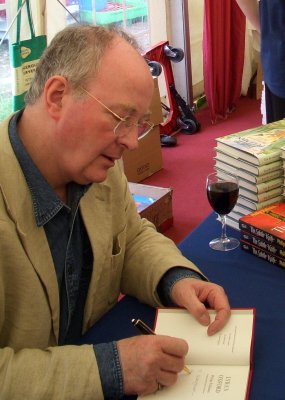
I get to my desk (in a very small room at the top of the house) at about 10, and fiddle about with the height of the desk and the chair until I’m comfortable. I have a desk that I can raise or lower according to the state of my aching back. Sometimes I stand at it, and sometimes I have it high up to write at, and sometimes a bit lower to type.

The Guardian, 'My writing day' series, 23 December 2017 source ↗

Others on this question

View all 17 →
Hilary Mantel Novelist and critic
I used to be a late starter, but now I get up in the dark like a medieval monk, commit unmediated scribble to a notebook, and go back to bed about six, hoping to sleep for another two hours and to wake slowly and in silence. Random noise, voices in other rooms, get me off to a savage, disorderly start, but if I am left in peace to reach for a pen, I feel through my fingertips what sort of day it is.
Recorded The Guardian, 'My writing day' series, 16 April 2016 source ↗
Will Self Novelist, essayist and journalist
When I’m working on a novel I type the initial draft first thing in the morning. Really: first thing. For preference, I have a cigarette ready-rolled and a coffee percolator loaded the night before; then I simply roll out of bed, fuel up and set to it. I believe the dreaming and imagining faculties are closely related, such that wreathed in night-time visions I find it possible to suspend disbelief in the very act of making stuff up.
Recorded The Guardian, 'My writing day' series, 18 June 2016 source ↗
Haruki Murakami Novelist, short-story writer and translator
When I’m in writing mode for a novel, I get up at four a.m. and work for five to six hours. In the afternoon, I run for ten kilometers or swim for fifteen hundred meters (or do both), then I read a bit and listen to some music. I go to bed at nine p.m. I keep to this routine every day without variation. The repetition itself becomes the important thing; it’s a form of mesmerism. I mesmerize myself to reach a deeper state of mind. But to hold to such repetition for so long—six months to a year—requires a good amount of mental and physical strength. In that sense, writing a long novel is like survival training. Physical strength is as necessary as artistic sensitivity.
Recorded John Wray, The Paris Review, issue 170, Summer 2004, 1 January 2004 source ↗
Toni Morrison Novelist and editor; Nobel laureate in Literature, 1993
Writing before dawn began as a necessity—I had small children when I first began to write and I needed to use the time before they said, “Mama”—and that was always around five in the morning. Many years later, after I stopped working at Random House, I just stayed at home for a couple of years. I discovered things about myself I had never thought about before.
Recorded Elissa Schappell, The Paris Review, issue 128, Fall 1993, 1 January 1993 source ↗

More on daily life

Also answered this

Yaa Gyasi, Hilary Mantel, Haruki Murakami, Colm Tóibín, Toni Morrison, Will Self

Search the directory for somebody in particular.

Explore further

Report this answer