Skip to content

The question

What counsel has proved most valuable to you?

Originally asked

Vogue, to one guest at a time, on camera, 73 Questions

A repeated rapid-fire prompt in Vogue's 73 Questions, verified in separate English- and Korean-language episodes.

You answer as yourself. Nobody on FLAPSS answers as anybody else.

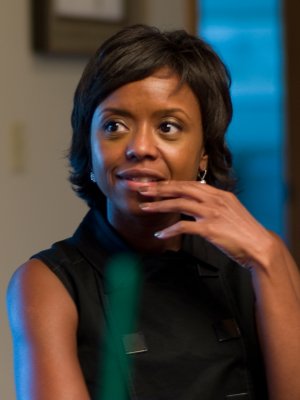
Mellody Hobson

Co-chief executive and president of Ariel Investments

Recorded said elsewhere, not written here
He says: Take your gloves off, Mellody, but use your power for good. He's giving me my hands back. Use your power for good. And I have never - I've used that analogy in all things in my life, something as simple as getting my hands back, using my powers for good in the water but also day-to-day life using your power for good no matter who you are.

Kathleen J. McInnis, Smart Women, Smart Power podcast, Center for Strategic and International Studies, 28 August 2024 source ↗

Others on this question

View all 28 →
Paul Farmer Physician and medical anthropologist; co-founder of Partners In Health
I had lots of teachers encourage me. And I still know some of them, my high school teachers. But one of them encouraged me. She said, “Well, what do you want to do?” I said, “I want to be a doctor.” And she asked me where I wanted to go to school, and so I named all the Florida public universities which seemed within reach, financially. And she said, “Well, maybe you ought to apply to Duke, and maybe you’ll get a scholarship.” And I did both those things. I applied and got a scholarship.
Recorded Academy of Achievement interview, Cape Town, South Africa, 3 July 2009 source ↗
Cal Ripken Jr. Baseball player; holder of the record for consecutive games played
You know what? Eddie was probably the best leader by example and not so much by words. You know, sometimes if he said something, you know, then you had to stand up and listen to it, but for the most part, he taught me the importance of being there every single day.
Recorded Academy of Achievement interview, Washington, D.C., 18 August 2020 source ↗
Pete Rozelle Commissioner of the National Football League, 1960–1989
It was a very simple thing. It was a church camp, I think. I was there about two or three days, very young, and I just remember some counselor telling us that reputation is what people think you are, and your character is what you are. So if you have a bad reputation, you might as well have a bad character, and it pays to have a good reputation and a good character.
Recorded Academy of Achievement interview, Rancho Santa Fe, California, 15 May 1991 source ↗
Frederick W. Smith Founder and long-serving chairman of FedEx Corporation
When I first met Sergeant Jackson I had grown a mustache and had taken up the affectation of smoking cigars, because I thought this made me look, you know, quite dashing and much older than my 22 years, or what have you. And the first thing that Sergeant Jackson did after I asked him to, in essence, take the insignia off, you know, just tell me straight up what I could do to improve my performance. And he told me, he said, “Well, the first thing, shave off that ridiculous mustache, and quite smoking the cigars — because you look absurd — and be yourself.” And I don’t think I ever forgot that. I don’t think I ever tried an affectation after that point in my life.
Recorded Academy of Achievement interview, Jackson Hole, Wyoming, 23 May 1998 source ↗

More from Mellody Hobson

View profile →
Question What fills you with the most pride? Identity & self
I literally said to them - all of our faces were on the - in the boxes on Zoom. And I welled up. And I said, oh my God, this is my dream. This is what I want - I've wanted to see my whole life of working at Ariel and all the things we've built, and making sure we all have a shot at this - narrowing this wealth gap, and putting our stamp on the industry and society.
Recorded Kathleen J. McInnis, Smart Women, Smart Power podcast, Center for Strategic and International Studies, 28 August 2024 source ↗
Question If you could put a message on a giant billboard, what would it say and why? Time & hindsight
We cannot afford to be color blind. We have to be color brave. We have to be willing, as teachers and parents and entrepreneurs and scientists, we have to be willing to have proactive conversations about race with honesty and understanding and courage, not because it's the right thing to do, but because it's the smart thing to do, because our businesses and our products and our science, our research, all of that will be better with greater diversity.
Recorded TED2014, 20 March 2014 source ↗

More on time & hindsight

Also answered this

Frederick W. Smith, Lisa Su, Charlie Munger, Joan Baez, Ralph Fiennes, Arnold Schwarzenegger

Search the directory for somebody in particular.

Explore further

Report this answer