Skip to content

The question

How close have you come to dying?

Originally asked

The Guardian, to a different person each week, The Q&A

A recurring Guardian Q&A prompt asked directly across respondents and years.

You answer as yourself. Nobody on FLAPSS answers as anybody else.

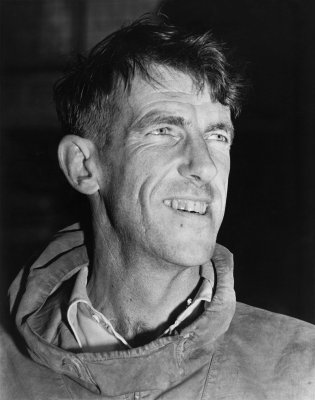
Edmund Hillary

Mountaineer and explorer; first ascent of Everest, 1953

Recorded said elsewhere, not written here
I had one experience on the ice-fall with Tenzing. We were actually descending after having been further up the mountain, and it was getting close towards dark so we wanted to get through the ice-fall before darkness fell. We were roped together, but I was rushing down ahead in the lead. About halfway down there was a narrow crevasse. I guess it was about four feet wide, but just a bit too wide to step across. On the lower lip was a great chunk of ice stuck against the ice wall, and we’d used that as sort of a stepping stone to get over the gap. I came rushing down the hill without thinking too carefully. I just leapt in the air and landed on the chunk of ice, whereupon the chunk of ice broke off and dropped into the crevasse with me on top of it. It was interesting how everything seemed to start going slowly, even though I was free-falling into the crevasse. My mind, obviously, was working very quickly indeed. The great chunk of ice started tipping over and I realized, if I wasn’t careful, I’d be crushed between the ice and the wall of the crevasse. So I just sort of bent my knees and leapt in the air. I was still falling, but now I was a couple of feet clear of the chunk of ice. Time really seemed to pass even though I was falling clear, and I realized that unless the rope came tight fairly soon, I would come to a rather sticky end on the bottom of the crevasse. Up top, Tenzing had acted very quickly. He had thrust his ice axe into the snow, whipped the rope around it, and the rope came tight with a twang, and I was stopped and swung in against the ice wall. The great chunk of ice just carried on and smashed to smithereens at the bottom of the crevasse. Then really the rest was what I would have called a routine mountaineering matter. I had my ice axe and my crampons on my feet, so I chipped steps in the side. I was able to bridge the crevasse, and I worked my way up to the top and got safely out. I wouldn’t have said at any stage, because it all happened so quickly, fear really didn’t have much opportunity to emerge. My only idea was to get safely out of this unfortunate predicament. And of course, without Tenzing’s very competent mountaineer’s response, I certainly wouldn’t have made it. But once he had stopped me, then I was able to, using the techniques of mountaineering, to get myself safely to the top again.

Academy of Achievement interview source ↗

Others on this question

View all 209 →
Paapa Essiedu British actor
In 2016, the moment my agent rang me to tell me I’d got the part of Hamlet for the RSC. While I was on the phone, I looked to my left and turned to the right, and a bus whizzed by and the wing mirror was so close to me that it knocked my hat off.
Recorded The Guardian, The Q&A, The Guardian, 18 November 2023 source ↗
When I had cancer. I was having a shave and thought: “Are you meant to have a big hard lump on one side of your neck?”
Recorded The Q&A, The Guardian, 1 February 2025 source ↗
I was stabbed in my 20s. It was a late-night mugging and, while taking my wallet, they stabbed me in my chest.
Recorded The Q&A, The Guardian, 18 April 2026 source ↗
Gloria Steinem Writer and feminist organiser
I’ve had cancer three times, but never felt close to death except when I walked between parked cars on my street and a car sped past my nose.
Recorded The Guardian, The Q&A, The Guardian, 4 March 2017 source ↗

More from Edmund Hillary

View profile →
Question What line from a parent, teacher, or mentor do you still repeat to yourself? Time & hindsight
My mother used to say to me a thing which, when I look back on it, wasn’t terribly logical. — and I had a pretty hearty appetite, but when I had had a large meal put in front of me, and even I couldn’t get through it, she would say, “Edmund, remember the starving millions in Asia.” Now what possible use my consuming it would do for the starving millions in Asia, I don’t really know, but the fact remains that I was brought up to think about the starving millions in Asia. That meant I had to clean my plate up and not waste it. Later on, I got more involved with the starving millions in Asia, perhaps in a slightly more practical way: helping some of them with schooling and hospitaling and even in agriculture.
Recorded Academy of Achievement interview source ↗
Question As a child, what career or life did you imagine for yourself? Identity & self
I really had no idea whatsoever. I feel that my life developed as I went along. I was never one of those people who, at an early age, had picked an objective and worked steadily towards it. All I knew was that I wanted to get involved in adventurous activity. I didn’t have any specific type of activity in mind, but I wanted to do things that were exciting and adventurous. I had a fairly diffused feeling as to what precisely it should be.
Recorded Academy of Achievement interview source ↗
Question What does everyone in your world seem to agree on that you think is wrong? Values & belief
The press and the public have created an image of Ed Hillary, hero and explorer which simply doesn’t exist. They’ve painted a picture of me as a heroic type, full of enormous courage, tremendous strength, undying enthusiasm and all the rest of it. But it’s all really just a story, that’s been written up in the newspapers. I’m a person, as I’ve said, of modest abilities, with a good deal of determination, and I do quite a lot of planning ahead. With careful planning and good motivation, I think you can often achieve things that other much more talented people would probably do much more easily.
Recorded Academy of Achievement interview source ↗
Question What is the hardest thing that has happened to you, and what did you carry out of it? Failure & regret
Well, then of course, came the disaster in 1975, when my wife and my youngest daughter were flying into the Nepal hills where I was building a hospital and their plane crashed and they were killed. And this certainly, for me, was an absolute disaster, really because the two people that meant most to me in life had been killed in one fell swoop. It did take me quite a number of years to get over it. I found the only way to deal with it was to carry on very energetically, doing the things that we had all been doing together, which was largely building schools and things for the mountain people. Although, people used to say to me, “Time is the great healer,” certainly for the first two years I simply didn’t accept this. But, time was a great healer and after the years passed, the memories still remain. But, I think quite a lot of the pain tends to fade a little bit, and life did become a little bit easier.
Recorded Academy of Achievement interview source ↗
Question Which problem are you still chipping away at? Craft & work
I think most of our major challenges are not going to be in the physical field at all. I think they’re going to be in the field of human relations, of getting on with each other, of contributing. People accepting that they have to contribute something, their thoughts, their ideas, maybe even their money, towards producing a world society that is perhaps a little bit more honest and reasonable than it is now.
Recorded Academy of Achievement interview source ↗
Question How much should instinct count in big decisions? Craft & work
I think it was a combination of feeling and judgment. I happened to be that sort of person that enjoyed making out plans, but I also enjoy changing plans. On an expedition, although I may start out with a detailed plan, I’m prepared to change it at any moment and completely redo it. So our expeditions turned out to be very adaptable ones. We achieved the final objectives just the same as many other expeditions, but maybe we had more fun in the process because it seemed something we could vary. We still carried on to achieve our major objectives.
Recorded Academy of Achievement interview source ↗

More on death & what remains

Also answered this

John Lewis, Clive Myrie, Louis Theroux, Winston Churchill, Edwina Currie, Anita Rani

Search the directory for somebody in particular.

Explore further

Report this answer