Skip to content

The question

How do you balance creative work with everything else in your life?

Originally asked

The Creative Independent, to working artists, its interview series

The Creative Independent repeatedly asks working artists how they divide time between creative practice and administrative, family, or second-job obligations.

You answer as yourself. Nobody on FLAPSS answers as anybody else.

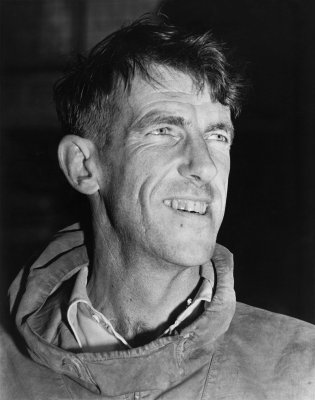
Edmund Hillary

Mountaineer and explorer; first ascent of Everest, 1953

Recorded said elsewhere, not written here
In the first 33 years of my life which is up until I climbed Everest, I was a very restless and slightly unhappy sort of person. I really didn’t have a great deal of social life, but I’d become very interested in adventurous activities. Perhaps, I was, in some respects something of a loner. But after I got married, that certainly changed my life very considerably, indeed. I found that it was possible to mix having a family with continuing on with adventurous activities, but I think a great deal of that was having a suitable wife. My wife was very, long-suffering. She knew that there were certain things I wanted to do and she was happy that I should do them. She was prepared to put up with considerable periods of being alone with the kids. She, was marvelous, so it made it possible for me to do the things that I wanted to do as well.

Academy of Achievement interview source ↗

Others on this question

View all 2 →
Barack Obama 44th President of the United States, 2009–2017; United States Senator from Illinois 2005–2008
It's hard - truthfully the main thing other than work is just making sure that I'm spending enough time with michelle and the girls. The big advantage I have is that I live above the store - so I have no commute! So we make sure that when I'm in DC I never miss dinner with them at 6:30 pm - even if I have to go back down to the Oval for work later in the evening. I do work out every morning as well, and try to get a basketball or golf game in on the weekends just to get out of the bubble.
Recorded Reddit r/IAmA, Reddit (archived), 29 August 2012 source ↗

More from Edmund Hillary

View profile →
Question What worries you about getting older? Time & hindsight
I’ve been very fortunate in that respect. In the early days I liked to be the bomb of the expedition, and rush on ahead and do things faster than anybody else. Those days merged very pleasantly into periods when I organized and inspired expeditions and selected these younger people who were then the bombs of the operation. And then it drifted into this involvement with the people of the area, still loving the mountains, but finding the people just as important too. And on and on it’s gone. As I get older and less physically capable, I find other challenges have grown up and become just as important to me.
Recorded Academy of Achievement interview source ↗
Question Which book reshaped how you think, and in what way? Taste & recommendation
Well my memory for names is absolutely appalling, but I know I did pass through a phase of books like King Solomon’s Mines. H. Rider Haggard was the author, and he wrote these great romantic adventure stories. I used to enjoy Georgette Heyer, in which the hero was usually a rather middle-aged gentleman, a very good sword fighter, with a beautiful young lady and all the rest of it. Great sword fighting and all highly romantic, adventurous activity. I used to find these things quite entertaining. I even passed through a phase when I quite enjoyed Western stories. Nowadays, I find them a little on the naive side but, for a period, I found the Western stories quite entertaining light reading. They are very romanticized, as we all know. Later on, I became much more interested in reading biographies, particularly about people who had made their mark in the community. I still enjoy reading books of that nature.
Recorded Academy of Achievement interview source ↗
Question What is the biggest professional obstacle you have faced? Craft & work
But, of course, we had one problem that the modern mountaineer doesn’t have. That is, this psychological barrier. We really didn’t know whether it was humanly possible to reach the top of Mt. Everest. And even using oxygen as we were, if we did get to the top, we weren’t at all sure whether we wouldn’t drop dead or something of that nature. All the physiologists had warned us that the altitude at the summit of Everest was a very marginal altitude and might be extremely dangerous. So, one had this feeling in your mind all the time that maybe you were pushing things a bit beyond what humans were meant to do and you couldn’t ignore that feeling. But, because of strong motivation, you keep plugging on and you seem to be going okay and nothing seems to be going wrong, so you persist. And we persisted, of course, and ultimately, set foot on the summit.
Recorded Academy of Achievement interview source ↗
Question What are you still hoping to finish? Death & what remains
As I’ve gotten older, my goals have become more solidified. My main concentration is on the welfare of the people I’ve worked with in the Himalayas and on human welfare in general. I’m also extremely interested in the environment and trying to encourage people to be more concerned about what we’re doing to our world. Now I’m just one of thousands and thousands of people who have these same views these days. I think this is one of the great steps forward we’ve seen in modern decades — the considerable growing interest that people have in the environment and in keeping it reasonably clean and wholesome. I certainly hope it remains that way.
Recorded Academy of Achievement interview source ↗
Question How much should instinct count in big decisions? Craft & work
I think it was a combination of feeling and judgment. I happened to be that sort of person that enjoyed making out plans, but I also enjoy changing plans. On an expedition, although I may start out with a detailed plan, I’m prepared to change it at any moment and completely redo it. So our expeditions turned out to be very adaptable ones. We achieved the final objectives just the same as many other expeditions, but maybe we had more fun in the process because it seemed something we could vary. We still carried on to achieve our major objectives.
Recorded Academy of Achievement interview source ↗
Question As a child, what career or life did you imagine for yourself? Identity & self
I really had no idea whatsoever. I feel that my life developed as I went along. I was never one of those people who, at an early age, had picked an objective and worked steadily towards it. All I knew was that I wanted to get involved in adventurous activity. I didn’t have any specific type of activity in mind, but I wanted to do things that were exciting and adventurous. I had a fairly diffused feeling as to what precisely it should be.
Recorded Academy of Achievement interview source ↗

More on daily life

Also answered this

Barack Obama

Search the directory for somebody in particular.

Explore further

Report this answer