Skip to content

The question

Which problem are you still chipping away at?

Originally asked

Lifehacker, to people about their working day, How I Work

Lifehacker repeatedly used this exact closing prompt in its named How I Work questionnaire.

You answer as yourself. Nobody on FLAPSS answers as anybody else.

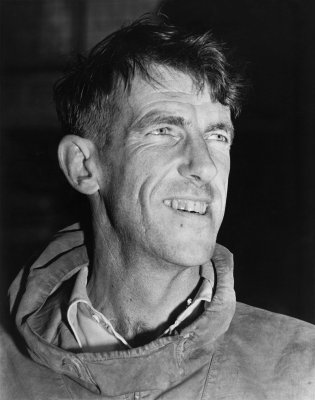
Edmund Hillary

Mountaineer and explorer; first ascent of Everest, 1953

Recorded said elsewhere, not written here
I think most of our major challenges are not going to be in the physical field at all. I think they’re going to be in the field of human relations, of getting on with each other, of contributing. People accepting that they have to contribute something, their thoughts, their ideas, maybe even their money, towards producing a world society that is perhaps a little bit more honest and reasonable than it is now.

Academy of Achievement interview source ↗

Others on this question

View all 12 →
Mario Molina Atmospheric chemist; Nobel laureate in Chemistry, 1995
I certainly want to continue trying to understand how the global environment functions. The earth as a system is a very complicated one. And to understand it, we need very many disciplines, very many different scientists working together. I want to continue working with my specialty, which is chemistry, with the atmosphere. There is still much to learn about chemical reactions that occur out there in the air, in the atmosphere. So one of my projects now is to really learn more about this pollution that occurs in cities and that is spreading more through the globe. To learn it in enough detail so we can better tackle it, we can better come up with new ways of using energy, for example, that are not so damaging to the environment.
Recorded Academy of Achievement interview, Sun Valley, Idaho, 29 June 1996 source ↗
Desmond Tutu Anglican Archbishop of Cape Town; chair of South Africa’s Truth and Reconciliation Commission; Nobel Peace Prize, 1984
So a great deal has changed, but we in the Truth and Reconciliation Commission said, “Watch it. You can kiss reconciliation and forgiveness goodbye, unless the gap between the rich and the poor — the haves and the have-nots — is narrowed, and narrowed quickly and dramatically.” So yes, we face very, very considerable problems.
Recorded Academy of Achievement interview source ↗
David Vélez Co-founder and chief executive of Nubank
I think a lot of that first wave of entrepreneurship was missing the product of localization, and they weren't really asking the question, "What are the big, impactful products or problems that we got to solve locally, and forget about the U.S. or forget about Europe?"
Recorded Marco Quiroz-Gutierrez, interview, Fortune, 9 October 2023 source ↗
Christiane Nüsslein-Volhard Developmental biologist; Nobel laureate in Physiology or Medicine, 1995
we know the fish, we know the worm, we know the fly, but we don’t know the links between and we don’t know, when we go back to the branches in evolution, we really don’t know what happened there when they branched and how they divert and what is the major drive for evolution.
Recorded Marika Griehsel, Interview at the 53rd Lindau Nobel Laureate Meeting, 30 June–4 July 2003, Nobel Prize Outreach, 1 July 2003 source ↗

More from Edmund Hillary

View profile →
Question What does everyone in your world seem to agree on that you think is wrong? Values & belief
The press and the public have created an image of Ed Hillary, hero and explorer which simply doesn’t exist. They’ve painted a picture of me as a heroic type, full of enormous courage, tremendous strength, undying enthusiasm and all the rest of it. But it’s all really just a story, that’s been written up in the newspapers. I’m a person, as I’ve said, of modest abilities, with a good deal of determination, and I do quite a lot of planning ahead. With careful planning and good motivation, I think you can often achieve things that other much more talented people would probably do much more easily.
Recorded Academy of Achievement interview source ↗
Question Which teacher, parent, coach, or friend most made you who you are, and what did you learn from them? Relationships
I did have — definitely — one heroic figure who impressed me very much indeed, and that was the great Antarctic explorer, Shackleton. Shackleton I always admired because he was a tough man and a very good leader. And whenever he was in difficult circumstances, which he frequently was, he seemed to have the great ability to inspire his men and lead his party safely out of those conditions. So certainly Shackleton, I would have said, more than anything, was a role model for me.
Recorded Academy of Achievement interview source ↗
Question What lesson has mattered most in your life? Time & hindsight
I think motivation is the single most important factor in any sort of success. Physical fitness is important, technical skill is important, and maybe even the desire for money is important in some respects. But a sort of basic motivation, the desire to succeed, to stretch yourself to the utmost is the most important factor. Certainly in the field of exploration and activity, it’s the thing that makes the difference between someone who does really well and someone who doesn’t.
Recorded Academy of Achievement interview source ↗
Question As a child, what career or life did you imagine for yourself? Identity & self
I really had no idea whatsoever. I feel that my life developed as I went along. I was never one of those people who, at an early age, had picked an objective and worked steadily towards it. All I knew was that I wanted to get involved in adventurous activity. I didn’t have any specific type of activity in mind, but I wanted to do things that were exciting and adventurous. I had a fairly diffused feeling as to what precisely it should be.
Recorded Academy of Achievement interview source ↗
Question Which book reshaped how you think, and in what way? Taste & recommendation
Well my memory for names is absolutely appalling, but I know I did pass through a phase of books like King Solomon’s Mines. H. Rider Haggard was the author, and he wrote these great romantic adventure stories. I used to enjoy Georgette Heyer, in which the hero was usually a rather middle-aged gentleman, a very good sword fighter, with a beautiful young lady and all the rest of it. Great sword fighting and all highly romantic, adventurous activity. I used to find these things quite entertaining. I even passed through a phase when I quite enjoyed Western stories. Nowadays, I find them a little on the naive side but, for a period, I found the Western stories quite entertaining light reading. They are very romanticized, as we all know. Later on, I became much more interested in reading biographies, particularly about people who had made their mark in the community. I still enjoy reading books of that nature.
Recorded Academy of Achievement interview source ↗
Question What are you unwilling to optimise? Values & belief
I still regard adventure pretty much as a hobby to tell you the honest truth, and I think this approach to it keeps one refreshed almost. I think if you just regard adventure as a business, working becomes very boring as many other businesses can become. But even though adventure changed my life considerably, both in what I was doing and even economically, I’ve always regarded myself in a sense as a competent amateur.
Recorded Academy of Achievement interview source ↗

More on craft & work

Also answered this

John Lewis, Mohamed ElBaradei, Bill Clinton, Desmond Tutu, Rosa Parks, David Vélez

Search the directory for somebody in particular.

Explore further

Report this answer