Skip to content
Edmund Hillary

Mountaineer and explorer; first ascent of Everest, 1953

Recorded said elsewhere, not written here
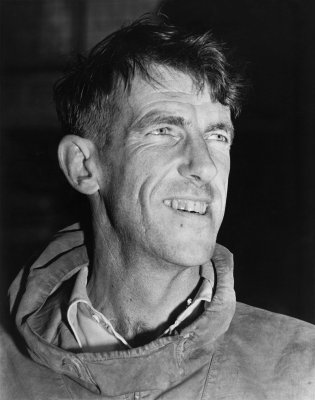
The press and the public have created an image of Ed Hillary, hero and explorer which simply doesn’t exist. They’ve painted a picture of me as a heroic type, full of enormous courage, tremendous strength, undying enthusiasm and all the rest of it. But it’s all really just a story, that’s been written up in the newspapers. I’m a person, as I’ve said, of modest abilities, with a good deal of determination, and I do quite a lot of planning ahead. With careful planning and good motivation, I think you can often achieve things that other much more talented people would probably do much more easily.

Academy of Achievement interview source ↗

Others on this question

View all 80 →
Wisława Szymborska Poet and essayist; Nobel laureate in Literature, 1996
But my answer is this: inspiration is not the exclusive privilege of poets or artists generally. There is, has been, and will always be a certain group of people whom inspiration visits. It’s made up of all those who’ve consciously chosen their calling and do their job with love and imagination. It may include doctors, teachers, gardeners – and I could list a hundred more professions. Their work becomes one continuous adventure as long as they manage to keep discovering new challenges in it. Difficulties and setbacks never quell their curiosity. A swarm of new questions emerges from every problem they solve. Whatever inspiration is, it’s born from a continuous “I don’t know.”
Recorded Swedish Academy, Stockholm, 7 December 1996, The Nobel Foundation (nobelprize.org), 7 December 1996 source ↗
David Vélez Co-founder and chief executive of Nubank
I always say the Nubank story was very unlikely. It was a very low probability event. Again. We were going after these very big incumbent banks. Everybody told me, you know, you're Colombian. You have no idea what you're doing in Brazil. They're going to crush you. Like, don't. Just don't do it. And I did it mostly because everybody told me I couldn't do it. And so, if somebody tells me I can't do something, I want to go do it.
Recorded John Waldron, Goldman Sachs Talks, Goldman Sachs (official event transcript) source ↗
Wole Soyinka Playwright, poet and novelist; Nobel laureate in Literature, 1986
Yes, I do. I do, but I were part company with certain schools of writers that I do not believe that it is necessarily the duty of the writer. I don’t believe that. If a writer is true to his vocation, to his or her vocation, the very process of creativity enlarges these human horizons. It provides insights, even when you’re not writing, when your writing’s not dealing with a concrete political situation.
Recorded Simon Stanford, NobelPrize.org (Nobel Prize Outreach), 28 April 2005 source ↗
Christiane Nüsslein-Volhard Developmental biologist; Nobel laureate in Physiology or Medicine, 1995
I continued the work on dorsal, discovered the recessive phenotype and interpreted the phenotype postulating a gradient determining the dorsoventral axis. At that time, gradients were not widely accepted as mechanisms, in particular biochemists were highly sceptical, however the Tübingen influence made such models attractive to me.
Recorded Laureate-written autobiography for Les Prix Nobel, Nobel Prize Outreach, 1 December 1995 source ↗

More from Edmund Hillary

View profile →
Question How much should instinct count in big decisions? Craft & work
I think it was a combination of feeling and judgment. I happened to be that sort of person that enjoyed making out plans, but I also enjoy changing plans. On an expedition, although I may start out with a detailed plan, I’m prepared to change it at any moment and completely redo it. So our expeditions turned out to be very adaptable ones. We achieved the final objectives just the same as many other expeditions, but maybe we had more fun in the process because it seemed something we could vary. We still carried on to achieve our major objectives.
Recorded Academy of Achievement interview source ↗
Question Which book reshaped how you think, and in what way? Taste & recommendation
Well my memory for names is absolutely appalling, but I know I did pass through a phase of books like King Solomon’s Mines. H. Rider Haggard was the author, and he wrote these great romantic adventure stories. I used to enjoy Georgette Heyer, in which the hero was usually a rather middle-aged gentleman, a very good sword fighter, with a beautiful young lady and all the rest of it. Great sword fighting and all highly romantic, adventurous activity. I used to find these things quite entertaining. I even passed through a phase when I quite enjoyed Western stories. Nowadays, I find them a little on the naive side but, for a period, I found the Western stories quite entertaining light reading. They are very romanticized, as we all know. Later on, I became much more interested in reading biographies, particularly about people who had made their mark in the community. I still enjoy reading books of that nature.
Recorded Academy of Achievement interview source ↗
Question How close have you come to dying? Death & what remains
I had one experience on the ice-fall with Tenzing. We were actually descending after having been further up the mountain, and it was getting close towards dark so we wanted to get through the ice-fall before darkness fell. We were roped together, but I was rushing down ahead in the lead. About halfway down there was a narrow crevasse. I guess it was about four feet wide, but just a bit too wide to step across. On the lower lip was a great chunk of ice stuck against the ice wall, and we’d used that as sort of a stepping stone to get over the gap. I came rushing down the hill without thinking too carefully. I just leapt in the air and landed on the chunk of ice, whereupon the chunk of ice broke off and dropped into the crevasse with me on top of it. It was interesting how everything seemed to start going slowly, even though I was free-falling into the crevasse. My mind, obviously, was working very quickly indeed. The great chunk of ice started tipping over and I realized, if I wasn’t careful, I’d be crushed between the ice and the wall of the crevasse. So I just sort of bent my knees and leapt in the air. I was still falling, but now I was a couple of feet clear of the chunk of ice. Time really seemed to pass even though I was falling clear, and I realized that unless the rope came tight fairly soon, I would come to a rather sticky end on the bottom of the crevasse. Up top, Tenzing had acted very quickly. He had thrust his ice axe into the snow, whipped the rope around it, and the rope came tight with a twang, and I was stopped and swung in against the ice wall. The great chunk of ice just carried on and smashed to smithereens at the bottom of the crevasse. Then really the rest was what I would have called a routine mountaineering matter. I had my ice axe and my crampons on my feet, so I chipped steps in the side. I was able to bridge the crevasse, and I worked my way up to the top and got safely out. I wouldn’t have said at any stage, because it all happened so quickly, fear really didn’t have much opportunity to emerge. My only idea was to get safely out of this unfortunate predicament. And of course, without Tenzing’s very competent mountaineer’s response, I certainly wouldn’t have made it. But once he had stopped me, then I was able to, using the techniques of mountaineering, to get myself safely to the top again.
Recorded Academy of Achievement interview source ↗
Question What period or moment in your life brought you the most joy? Time & hindsight
Those years from 1953 to 1975 were extremely happy years for me. I did many adventurous activities. I got deeply involved in these aid programs for the people of the Himalayas. I had a nice family, we took our family into the out-of-doors, we camped and we swam and we clambered around the hills. For me, it was a very full and a very happy existence.
Recorded Academy of Achievement interview source ↗
Question When were you most embarrassed? Failure & regret
I can always remember, when I was at high school we had a school sort of army battalion and because, at that time, I was one of the larger boys, I was appointed sergeant of the number one platoon, and I was always absolutely petrified that when I was meant to turn the platoon left or turn it right, I was really actually hopeless at knowing quite what to do. But fortunately, my platoon, who were really all the misfits in the school, the larger misfits, they stood by me, and some of them were quite good at knowing when to turn left or turn right. So whatever command I gave, they would do the right thing. We were a pretty good platoon as a consequence although, at the time, I felt an absolute idiot.
Recorded Academy of Achievement interview source ↗
Question What line from a parent, teacher, or mentor do you still repeat to yourself? Time & hindsight
My mother used to say to me a thing which, when I look back on it, wasn’t terribly logical. — and I had a pretty hearty appetite, but when I had had a large meal put in front of me, and even I couldn’t get through it, she would say, “Edmund, remember the starving millions in Asia.” Now what possible use my consuming it would do for the starving millions in Asia, I don’t really know, but the fact remains that I was brought up to think about the starving millions in Asia. That meant I had to clean my plate up and not waste it. Later on, I got more involved with the starving millions in Asia, perhaps in a slightly more practical way: helping some of them with schooling and hospitaling and even in agriculture.
Recorded Academy of Achievement interview source ↗

More on values & belief

Also answered this

Corazon Aquino, Ronald Reagan, Lee Kuan Yew, Mikhail Gorbachev, Eleanor Roosevelt, Barack Obama

Search the directory for somebody in particular.

Explore further

Report this answer