Skip to content
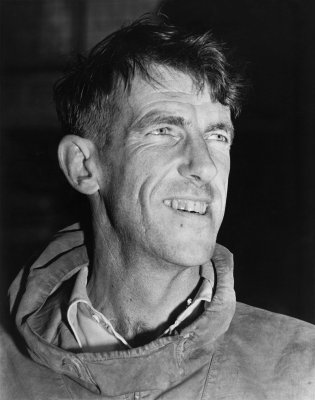
Edmund Hillary

Mountaineer and explorer; first ascent of Everest, 1953

Recorded said elsewhere, not written here
My mother used to say to me a thing which, when I look back on it, wasn’t terribly logical. — and I had a pretty hearty appetite, but when I had had a large meal put in front of me, and even I couldn’t get through it, she would say, “Edmund, remember the starving millions in Asia.” Now what possible use my consuming it would do for the starving millions in Asia, I don’t really know, but the fact remains that I was brought up to think about the starving millions in Asia. That meant I had to clean my plate up and not waste it. Later on, I got more involved with the starving millions in Asia, perhaps in a slightly more practical way: helping some of them with schooling and hospitaling and even in agriculture.

Academy of Achievement interview source ↗

Others on this question

View all 23 →
Henry R. Kravis Financier; co-founder of Kohlberg Kravis Roberts & Co.
One person that is my role model is my father. ... He’s a man who taught me something very important. And that was — give back to society what you’ve taken out.
Recorded Academy of Achievement interview, 12 February 1991 source ↗
Suzanne Farrell Ballerina and ballet master; répétiteur for the Balanchine Trust
I think he was a great philosopher. He had a wonderful theory that you live in the “now,” which I think is important. Along with living in the moment, you also have to assume the responsibility that goes along with it, and you don’t take your position lightly. But it also means that you get the full value of the moment that you are living, so you don’t look back on your life and say, “If only I hadn’t wasted time, if only I had done this.” You do the best you can. It was wonderful to be able to go home after a performance, and think, well it wasn’t maybe so good, but it was the best I could be at that time.
Recorded Academy of Achievement (achievement.org) source ↗
Ralph Nader Lawyer and consumer advocate; author of Unsafe at Any Speed
But if it did well, I’d remember what my parents told me, which was the hardest thing is not attaining success, it’s being able to endure it.
Recorded Academy of Achievement interview, 16 February 1991 source ↗
Gustavo Dudamel Conductor; Music and Artistic Director of the Los Angeles Philharmonic
Maestro Abreu always said something very, very beautiful. He said, “The culture for poor people cannot be a poor culture.” You know, and he said in the sense that for the poor people, for the people that needs, we have to give the best, the best that we can.
Recorded Academy of Achievement (achievement.org) source ↗

More from Edmund Hillary

View profile →
Question What are you best at that nobody watching would notice? Craft & work
I always have, in my expeditions, people who are academically far cleverer than I am, and even technically, far more competent. So if you want to lead an expedition, in a sense, you’ve got to keep ahead of them. These bright, competent characters you have with you who are marvelous to have on the expedition. And I’ve always found you can do that by, each night, when you go to bed, just let your mind dwell on the likely things that may happen next day, and think out carefully the sort of decisions that might be necessary to make in order to have the program carried through. So next day, when something happens, you’re the one that’s thought about it and you’re the one who has the ideas.
Recorded Academy of Achievement interview source ↗
Question What is the hardest thing that has happened to you, and what did you carry out of it? Failure & regret
Well, then of course, came the disaster in 1975, when my wife and my youngest daughter were flying into the Nepal hills where I was building a hospital and their plane crashed and they were killed. And this certainly, for me, was an absolute disaster, really because the two people that meant most to me in life had been killed in one fell swoop. It did take me quite a number of years to get over it. I found the only way to deal with it was to carry on very energetically, doing the things that we had all been doing together, which was largely building schools and things for the mountain people. Although, people used to say to me, “Time is the great healer,” certainly for the first two years I simply didn’t accept this. But, time was a great healer and after the years passed, the memories still remain. But, I think quite a lot of the pain tends to fade a little bit, and life did become a little bit easier.
Recorded Academy of Achievement interview source ↗
Question What period or moment in your life brought you the most joy? Time & hindsight
Those years from 1953 to 1975 were extremely happy years for me. I did many adventurous activities. I got deeply involved in these aid programs for the people of the Himalayas. I had a nice family, we took our family into the out-of-doors, we camped and we swam and we clambered around the hills. For me, it was a very full and a very happy existence.
Recorded Academy of Achievement interview source ↗
Question How close have you come to dying? Death & what remains
I had one experience on the ice-fall with Tenzing. We were actually descending after having been further up the mountain, and it was getting close towards dark so we wanted to get through the ice-fall before darkness fell. We were roped together, but I was rushing down ahead in the lead. About halfway down there was a narrow crevasse. I guess it was about four feet wide, but just a bit too wide to step across. On the lower lip was a great chunk of ice stuck against the ice wall, and we’d used that as sort of a stepping stone to get over the gap. I came rushing down the hill without thinking too carefully. I just leapt in the air and landed on the chunk of ice, whereupon the chunk of ice broke off and dropped into the crevasse with me on top of it. It was interesting how everything seemed to start going slowly, even though I was free-falling into the crevasse. My mind, obviously, was working very quickly indeed. The great chunk of ice started tipping over and I realized, if I wasn’t careful, I’d be crushed between the ice and the wall of the crevasse. So I just sort of bent my knees and leapt in the air. I was still falling, but now I was a couple of feet clear of the chunk of ice. Time really seemed to pass even though I was falling clear, and I realized that unless the rope came tight fairly soon, I would come to a rather sticky end on the bottom of the crevasse. Up top, Tenzing had acted very quickly. He had thrust his ice axe into the snow, whipped the rope around it, and the rope came tight with a twang, and I was stopped and swung in against the ice wall. The great chunk of ice just carried on and smashed to smithereens at the bottom of the crevasse. Then really the rest was what I would have called a routine mountaineering matter. I had my ice axe and my crampons on my feet, so I chipped steps in the side. I was able to bridge the crevasse, and I worked my way up to the top and got safely out. I wouldn’t have said at any stage, because it all happened so quickly, fear really didn’t have much opportunity to emerge. My only idea was to get safely out of this unfortunate predicament. And of course, without Tenzing’s very competent mountaineer’s response, I certainly wouldn’t have made it. But once he had stopped me, then I was able to, using the techniques of mountaineering, to get myself safely to the top again.
Recorded Academy of Achievement interview source ↗
Question Which book reshaped how you think, and in what way? Taste & recommendation
Well my memory for names is absolutely appalling, but I know I did pass through a phase of books like King Solomon’s Mines. H. Rider Haggard was the author, and he wrote these great romantic adventure stories. I used to enjoy Georgette Heyer, in which the hero was usually a rather middle-aged gentleman, a very good sword fighter, with a beautiful young lady and all the rest of it. Great sword fighting and all highly romantic, adventurous activity. I used to find these things quite entertaining. I even passed through a phase when I quite enjoyed Western stories. Nowadays, I find them a little on the naive side but, for a period, I found the Western stories quite entertaining light reading. They are very romanticized, as we all know. Later on, I became much more interested in reading biographies, particularly about people who had made their mark in the community. I still enjoy reading books of that nature.
Recorded Academy of Achievement interview source ↗
Question Which problem are you still chipping away at? Craft & work
I think most of our major challenges are not going to be in the physical field at all. I think they’re going to be in the field of human relations, of getting on with each other, of contributing. People accepting that they have to contribute something, their thoughts, their ideas, maybe even their money, towards producing a world society that is perhaps a little bit more honest and reasonable than it is now.
Recorded Academy of Achievement interview source ↗

More on time & hindsight

Also answered this

Coretta Scott King, Ellen Johnson Sirleaf, Ralph Nader, Jimmy Carter, Lynsey Addario, Bill Clinton

Search the directory for somebody in particular.

Explore further

Report this answer