Skip to content
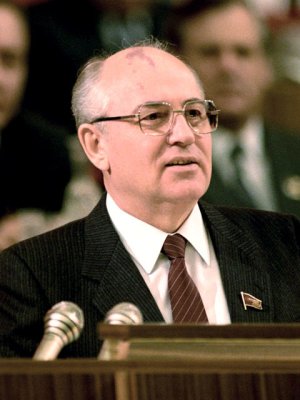
Mikhail Gorbachev

General Secretary of the Communist Party of the Soviet Union 1985–1991; President of the Soviet Union 1990–1991

Recorded said elsewhere, not written here
A period of transition to a new quality in all spheres of society's life is accompanied by painful phenomena. When we were initiating perestroika we failed to properly assess and foresee everything. Our society turned out to be hard to move off the ground, not ready for major changes which affect people's vital interests and make them leave behind everything to which they had become accustomed over many years. In the beginning we imprudently generated great expectations, without taking into account the fact that it takes time for people to realize that all have to live and work differently, to stop expecting that new life would be given from above.

Oslo City Hall, The Nobel Foundation, 5 June 1991 source ↗

Others on this question

View all 69 →
Robert S. Langer Biomedical engineer; Institute Professor at MIT
In fact, what I usually say to people, “Probably some of the most successful scientists are the ones that know how to deal with failure well.” Because it’s easy to feel good when you succeed. That’s an easy thing. But you’re probably going to fail in science a lot more than you succeed, so you really have to learn how to deal with it and not let it beat you.
Recorded Academy of Achievement interview, 25 October 2012 source ↗
Anthony Romero American lawyer; executive director of the American Civil Liberties Union
We have failed seven times up at bat, and we strike out, and I think, "How can I learn from that failure? What went wrong? What could I have done differently?" You have to take it apart to understand your failures. Failures teach you much more than your successes. Sometimes it is better just to pause on a setback, on a failure, on a screw-up, and say, "What did I learn from this?" You learn how to do it better and you recommit yourself.
Recorded Academy of Achievement interviewer, Academy of Achievement interview, New York, New York, 1 April 2005 source ↗
Sheryl Sandberg Former chief operating officer of Facebook; founder of LeanIn.org
Day one of my first job out of college, my boss found out that I didn't know how to enter data into Lotus 1-2-3. That's a spreadsheet—ask your parents. His mouth dropped open and he said, ‘I can't believe you got this job without knowing that”—and then walked out of the room. I went home convinced that I was going to be fired. I thought I was terrible at everything… but it turns out I was only terrible at spreadsheets.
Recorded University of California, Berkeley Commencement, Los Angeles Times, 14 May 2016 source ↗
Shinya Yamanaka Stem cell biologist; Nobel laureate in Physiology or Medicine, 2012
Working at the hospital, I found that my surgical skills were not as good as I expected. One time it took me two hours to do a surgical operation which could have been completed in 30 minutes by other surgeons. My supervisors were very tough on new residents like me, and I lost confidence in my ability.
Recorded Laureate-written autobiography for Les Prix Nobel, Nobel Prize Outreach, 1 December 2012 source ↗

More from Mikhail Gorbachev

View profile →
Question What does everyone in your world seem to agree on that you think is wrong? Values & belief
I have been suspected of utopian thinking more than once, and particularly when five years ago I proposed the elimination of nuclear weapons by the year 2000 and joint efforts to create a system of international security. It may well be that by that date it will not have happened. But look, merely five years have passed and have we not actually and noticeably moved in that direction?
Recorded Oslo City Hall, The Nobel Foundation, 5 June 1991 source ↗

More on failure & regret

Also answered this

Wendy Kopp, Theodore Roosevelt, Angela Merkel, Mohamed ElBaradei, John Lewis, Ben Bradlee

Search the directory for somebody in particular.

Explore further

Report this answer