The question

What scares you about getting older?

Originally asked

The Guardian, to a different person each week, The Q&A

A newer fixed question in The Guardian's rotating Q&A pool.

You answer as yourself. Nobody on FLAPSS answers as anybody else.

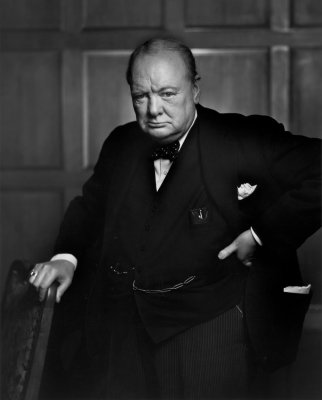
Winston Churchill

Prime Minister of the United Kingdom, 1940–1945 and 1951–1955; Member of Parliament 1900–1964

Recorded said elsewhere, not written here
One by one the more vigorous sports and exacting games fall away. Exceptional exertions are purchased only by a more pronounced and more prolonged fatigue. Muscles may relax, and feet and hands slow down; the nerve of youth and manhood may become less trusty. But painting is a friend who makes no undue demands, excites to no exhausting pursuits, keeps faithful pace even with feeble steps, and holds her canvas as a screen between us and the envious eyes of Time or the surly advance of Decrepitude. Happy are the painters, for they shall not be lonely.

Essay first published in the Strand Magazine in 1921–22 and collected in Amid These Storms, 1932, Winston S. Churchill, Painting as a Pastime, Project Gutenberg Canada, 1932 source ↗

Others on this question

View all 69 →
Alan Cumming Scottish actor, producer, director, writer and presenter
I think acting your age is allowing other people to make decisions for you about how you should behave and what is age-appropriate. I encourage people to live and not be tied down with other people's expectations of what you should be doing. If you want to do something, go and do it. We overly worship the altar of youth. It's not good for our mental health. As a culture, we need to get better at seeing the beauty in aging and the beauty in things that are not young.
Recorded Eric Spitznagel, Interview, AARP, 6 January 2025 source ↗
I understand that you lose the register of hearing that enables you to hear crickets, and when I can’t hear crickets in the summer I’ll be really sad.
Recorded The Q&A, The Guardian, 14 March 2026 source ↗

More from Winston Churchill

View profile →
Question What advice would you give your twenty-year-old self, and what should they ignore? Time & hindsight
Come on now all you young men, all over the world. You are needed more than ever now to fill the gap of a generation shorn by the War. You have not an hour to lose. You must take your places in life's fighting line. Twenty to twenty-five! These are the years! Don't be content with things as they are. 'The earth is yours and the fulness thereof'. Enter upon your inheritance, accept your responsibilities. Raise the glorious flags again, advance them upon the new enemies, who constantly gather upon the front of the human army, and have only to be assaulted to be overthrown. Don't take No for an answer. Never submit to failure.
Recorded Chapter of his autobiography, written at Chartwell in 1930, Winston S. Churchill, My Early Life (Thornton Butterworth, 1930), Project Gutenberg Canada, October 1930 source ↗
Question What single thing would improve the quality of your life? Daily life
The cultivation of a hobby and new forms of interest is therefore a policy of first importance to a public man. But this is not a business that can be undertaken in a day or swiftly improvised by a mere command of the will. The growth of alternative mental interests is a long process. The seeds must be carefully chosen; they must fall on good ground; they must be sedulously tended, if the vivifying fruits are to be at hand when needed. To be really happy and really safe, one ought to have at least two or three hobbies, and they must all be real.
Recorded Essay first published in the Strand Magazine in 1921–22 and collected in Amid These Storms, 1932, Winston S. Churchill, Painting as a Pastime, Project Gutenberg Canada, 1932 source ↗
Question Who do you turn to when you need advice? Relationships
My mother made the same brilliant impression upon my childhood's eye. She shone for me like the Evening Star. I loved her dearly—but at a distance. My nurse was my confidante. Mrs. Everest it was who looked after me and tended all my wants. It was to her I poured out my many troubles, both now and in my schooldays.
Recorded Chapter of his autobiography, written at Chartwell in 1930, Winston S. Churchill, My Early Life (Thornton Butterworth, 1930), Project Gutenberg Canada, October 1930 source ↗
Question What is your favourite side project? Craft & work
Painting is complete as a distraction. I know of nothing which, without exhausting the body, more entirely absorbs the mind. Whatever the worries of the hour or the threats of the future, once the picture has begun to flow along, there is no room for them in the mental screen. They pass out into shadow and darkness. All one's mental light, such as it is, becomes concentrated on the task. Time stands respectfully aside, and it is only after many hesitations that luncheon knocks gruffly at the door.
Recorded Essay first published in the Strand Magazine in 1921–22 and collected in Amid These Storms, 1932, Winston S. Churchill, Painting as a Pastime, Project Gutenberg Canada, 1932 source ↗
Question What do you do when you feel creatively blocked or stuck? Craft & work
At that moment the loud approaching sound of a motor-car was heard in the drive. From this chariot there stepped swiftly and lightly none other than the gifted wife of Sir John Lavery. 'Painting! But what are you hesitating about? Let me have a brush—the big one.' Splash into the turpentine, wallop into the blue and the white, frantic flourish on the palette—clean no longer—and then several large, fierce strokes and slashes of blue on the absolutely cowering canvas. Anyone could see that it could not hit back. No evil fate avenged the jaunty violence. The canvas grinned in helplessness before me. The spell was broken. The sickly inhibitions rolled away. I seized the largest brush and fell upon my victim with Berserk fury. I have never felt any awe of a canvas since.
Recorded Essay first published in the Strand Magazine in 1921–22 and collected in Amid These Storms, 1932, Winston S. Churchill, Painting as a Pastime, Project Gutenberg Canada, 1932 source ↗
Question Which book changed the way you think, and what did it change? Taste & recommendation
In history I decided to begin with Gibbon. Someone had told me that my father had read Gibbon with delight; that he knew whole pages of it by heart, and that it had greatly affected his style of speech and writing. So without more ado I set out upon the eight volumes of Dean Milman's edition of Gibbon's Decline and Fall of the Roman Empire . I was immediately dominated both by the story and the style. All through the long glistening middle hours of the Indian day, from when we quitted stables till the evening shadows proclaimed the hour of Polo, I devoured Gibbon. I rode triumphantly through it from end to end and enjoyed it all.
Recorded Chapter of his autobiography, written at Chartwell in 1930, Winston S. Churchill, My Early Life (Thornton Butterworth, 1930), Project Gutenberg Canada, October 1930 source ↗

More on time & hindsight

Also answered this

Jon Sopel, Edmund Hillary, George H. W. Bush, Jon Snow, Neil Gaiman, Paula Wilcox

Search the directory for somebody in particular.

Explore further

Report this answer