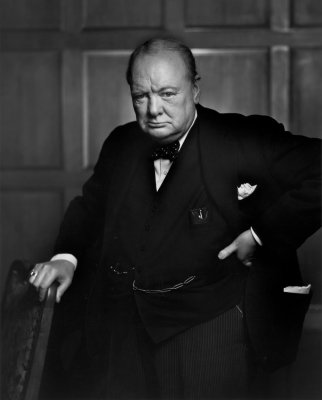
Managed profile Not claimed by Winston Churchill

Winston Churchill has not joined FLAPSS and has not endorsed it. This page is a reference record assembled from published interviews and public remarks. Every answer below is a direct quotation with the source and date shown next to it.

Is this you, or is something wrong?

Winston Churchill

Prime Minister of the United Kingdom, 1940–1945 and 1951–1955; Member of Parliament 1900–1964

United Kingdom · 1874–1965

Politics and public life

About

Served two terms as Prime Minister of the United Kingdom, leading the country through most of the Second World War. Held office as Home Secretary, First Lord of the Admiralty and Chancellor of the Exchequer earlier in his career. Awarded the Nobel Prize in Literature in 1953.

21 answers

Question What is your favourite side project? Craft & work read 32 other answers →
Painting is complete as a distraction. I know of nothing which, without exhausting the body, more entirely absorbs the mind. Whatever the worries of the hour or the threats of the future, once the picture has begun to flow along, there is no room for them in the mental screen. They pass out into shadow and darkness. All one's mental light, such as it is, becomes concentrated on the task. Time stands respectfully aside, and it is only after many hesitations that luncheon knocks gruffly at the door.
Recorded Essay first published in the Strand Magazine in 1921–22 and collected in Amid These Storms, 1932, Winston S. Churchill, Painting as a Pastime, Project Gutenberg Canada, 1932 source ↗
Question How does a new work begin for you? Craft & work read 85 other answers →
Having bought the colours, an easel, and a canvas, the next step was to begin. But what a step to take! The palette gleamed with beads of colour; fair and white rose the canvas; the empty brush hung poised, heavy with destiny, irresolute in the air. My hand seemed arrested by a silent veto.
Recorded Essay first published in the Strand Magazine in 1921–22 and collected in Amid These Storms, 1932, Winston S. Churchill, Painting as a Pastime, Project Gutenberg Canada, 1932 source ↗
Question What do you do when you feel creatively blocked or stuck? Craft & work read 81 other answers →
At that moment the loud approaching sound of a motor-car was heard in the drive. From this chariot there stepped swiftly and lightly none other than the gifted wife of Sir John Lavery. 'Painting! But what are you hesitating about? Let me have a brush—the big one.' Splash into the turpentine, wallop into the blue and the white, frantic flourish on the palette—clean no longer—and then several large, fierce strokes and slashes of blue on the absolutely cowering canvas. Anyone could see that it could not hit back. No evil fate avenged the jaunty violence. The canvas grinned in helplessness before me. The spell was broken. The sickly inhibitions rolled away. I seized the largest brush and fell upon my victim with Berserk fury. I have never felt any awe of a canvas since.
Recorded Essay first published in the Strand Magazine in 1921–22 and collected in Amid These Storms, 1932, Winston S. Churchill, Painting as a Pastime, Project Gutenberg Canada, 1932 source ↗
Question How much rewriting or revision do you do? Craft & work read 59 other answers →
First of all, you can correct mistakes much more easily. One sweep of the palette-knife 'lifts' the blood and tears of a morning from the canvas and enables a fresh start to be made; indeed the canvas is all the better for past impressions.
Recorded Essay first published in the Strand Magazine in 1921–22 and collected in Amid These Storms, 1932, Winston S. Churchill, Painting as a Pastime, Project Gutenberg Canada, 1932 source ↗
Question What is your worst intellectual habit? Craft & work read 30 other answers →
They had large resources of compulsion at their disposal, but I was stubborn. Where my reason, imagination or interest were not engaged, I would not or I could not learn. In all the twelve years I was at school no one ever succeeded in making me write a Latin verse or learn any Greek except the alphabet. I do not at all excuse myself for this foolish neglect of opportunities procured at so much expense by my parents and brought so forcibly to my attention by my Preceptors.
Recorded Chapter of his autobiography, written at Chartwell in 1930, Winston S. Churchill, My Early Life (Thornton Butterworth, 1930), Project Gutenberg Canada, October 1930 source ↗
Question What is the thing you are best at that nobody watching can see? Craft & work read 33 other answers →
Mr. Somervell—a most delightful man, to whom my debt is great—was charged with the duty of teaching the stupidest boys the most disregarded thing—namely, to write mere English. He knew how to do it. He taught it as no one else has ever taught it. Not only did we learn English parsing thoroughly, but we also practised continually English analysis. Mr. Somervell had a system of his own. He took a fairly long sentence and broke it up into its components by means of black, red, blue and green inks. Subject, verb, object: Relative Clauses, Conditional Clauses, Conjunctive and Disjunctive Clauses! Each had its colour and its bracket. It was a kind of drill. We did it almost daily. ... I learned it thoroughly. Thus I got into my bones the essential structure of the ordinary British sentence—which is a noble thing.
Recorded Chapter of his autobiography, written at Chartwell in 1930, Winston S. Churchill, My Early Life (Thornton Butterworth, 1930), Project Gutenberg Canada, October 1930 source ↗

Every quotation above is reproduced from the source shown beside it and has not been edited. Winston Churchill did not write these answers for FLAPSS. Request a correction or removal.