Skip to content

The question

If you could revise one chapter of your past, what would you change?

Originally asked

The Guardian, to a different person each week, The Q&A

Repeated verbatim in The Guardian's long-running Saturday Q&A; two publisher-hosted examples establish recurrence.

You answer as yourself. Nobody on FLAPSS answers as anybody else.

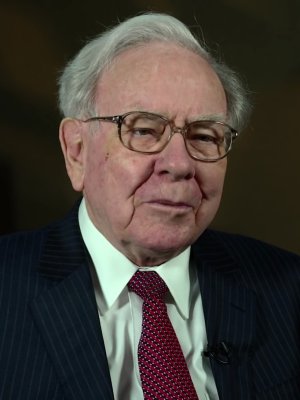
Warren Buffett

Chairman and chief executive of Berkshire Hathaway, 1970–2025

Recorded said elsewhere, not written here
In particular, my decision to sell McDonald's was a very big mistake. Overall, you would have been better off last year if I had regularly snuck off to the movies during market hours.

His letter to Berkshire Hathaway shareholders in the 1998 annual report, Berkshire Hathaway Inc., February 1999 source ↗

Others on this question

View all 203 →
Jason Isaacs English actor
I wouldn’t have spent so much time trying to be a professional skateboarder or snooker player.
Recorded The Guardian, The Q&A, The Guardian, 21 November 2020 source ↗
Tracy-Ann Oberman Actor and writer
I am a living self-help book – I’ve managed to train myself to never regret anything.
Recorded The Guardian, The Q&A, The Guardian, 28 August 2021 source ↗
Julia Ormond English actress
I wouldn’t have hurt as many people, and I would have thought more before speaking.
Recorded The Guardian, The Q&A, The Guardian, 27 March 2021 source ↗

More from Warren Buffett

View profile →
Question What became visible only after your working life slowed down or ended? Time & hindsight
I go in every day to the office. I don't accomplish hardly anything. I mean, in terms of – it just takes me way longer to do things. And Greg is so good. It was kind of embarrassing how good he is, because he has covered – you know, we've got about 200 businesses within Berkshire, you know, that came about, and I can't name the manager's names or their wives names, or – and I haven't seen them, you know, in a long time.
Recorded Becky Quick, CNBC Squawk Box, 31 March 2026 source ↗
Question What bad recommendations do people in your field repeat too often? Craft & work
Most investors, of course, have not made the study of business prospects a priority in their lives. If wise, they will conclude that they do not know enough about specific businesses to predict their future earning power. I have good news for these non-professionals: The typical investor doesn't need this skill. ... The goal of the non-professional should not be to pick winners – neither he nor his "helpers" can do that – but should rather be to own a cross-section of businesses that in aggregate are bound to do well. A low-cost S&P 500 index fund will achieve this goal.
Recorded Berkshire Hathaway annual shareholder letter, Berkshire Hathaway Inc., 28 February 2014 source ↗
Question What part of your job would surprise outsiders because it takes up so much of your time? Craft & work
The extraordinary delegation of authority now existing at Berkshire is the ideal antidote to bureaucracy. In an operating sense, Berkshire is not a giant company but rather a collection of large companies. At headquarters, we have never had a committee nor have we ever required our subsidiaries to submit budgets (though many use them as an important internal tool). We don't have a legal office nor departments that other companies take for granted: human relations, public relations, investor relations, strategy, acquisitions, you name it. We do, of course, have an active audit function; no sense being a damned fool.
Recorded Berkshire Hathaway annual shareholder letter, Berkshire Hathaway Inc., 27 February 2015 source ↗
Question Which thinking habit do you wish you could break? Craft & work
Ironically, though, this is also the purchase in which I made my biggest mistake - of a kind, however, never recognized on financial statements. We paid $600 million in 1989 for Gillette preferred shares that were convertible into 48 million (split-adjusted) common shares. Taking an alternative route with the $600 million, I probably could have purchased 60 million shares of common from the company. The market on the common was then about $10.50, and given that this would have been a huge private placement carrying important restrictions, I probably could have bought the stock at a discount of at least 5%. I can't be sure about this, but it's likely that Gillette's management would have been just as happy to have Berkshire opt for common. But I was far too clever to do that.
Recorded His letter to Berkshire Hathaway shareholders in the 1995 annual report, Berkshire Hathaway Inc., February 1996 source ↗
Question What are you unwilling to optimise? Values & belief
Charlie and I decided long ago that in an investment lifetime it's just too hard to make hundreds of smart decisions. That judgment became ever more compelling as Berkshire's capital mushroomed and the universe of investments that could significantly affect our results shrank dramatically. Therefore, we adopted a strategy that required our being smart - and not too smart at that - only a very few times. Indeed, we'll now settle for one good idea a year. (Charlie says it's my turn.)
Recorded His letter to Berkshire Hathaway shareholders in the 1993 annual report, Berkshire Hathaway Inc., February 1994 source ↗
Question What is one of the best investments you have made — of money, time, or energy? Money & investment
We've just passed a milestone: Twenty years ago, on January 3, 1972, Blue Chip Stamps (then an affiliate of Berkshire and later merged into it) bought control of See's Candy Shops, a West Coast manufacturer and retailer of boxed-chocolates. The nominal price that the sellers were asking - calculated on the 100% ownership we ultimately attained - was $40 million. But the company had $10 million of excess cash, and therefore the true offering price was $30 million. Charlie and I, not yet fully appreciative of the value of an economic franchise, looked at the company's mere $7 million of tangible net worth and said $25 million was as high as we would go (and we meant it). Fortunately, the sellers accepted our offer. The sales of trading stamps by Blue Chip thereafter declined from $102.5 million in 1972 to $1.2 million in 1991. But See's candy sales in the same period increased from $29 million to $196 million. Moreover, profits at See's grew even faster than sales, from $4.2 million pre-tax in 1972 to $42.4 million last year.
Recorded His letter to Berkshire Hathaway shareholders in the 1991 annual report, Berkshire Hathaway Inc., February 1992 source ↗

More on failure & regret

Also answered this

Gino D'Acampo, Bobbi Brown, Katharine Hamnett, Douglas Stuart, Shaznay Lewis, Bill Bryson

Search the directory for somebody in particular.

Explore further

Report this answer