Skip to content
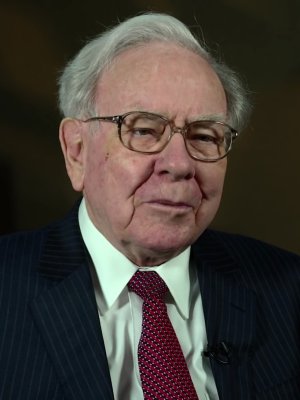
Warren Buffett

Chairman and chief executive of Berkshire Hathaway, 1970–2025

Recorded said elsewhere, not written here
Yeah and we get calls all the time, and there's so many calls, but the like I said, it takes me five seconds to say no. It takes, Greg's a little more polite than I am, but I just as soon get the calls just to see what people are doing. But they aren't offering anything that's at an attractive price, and what they want is a trade.

Becky Quick, CNBC “Squawk Box”, recorded in Omaha; CNBC's own transcript of its own broadcast, 31 March 2026 source ↗

Others on this question

View all 22 →
Derek Sivers Founder of CD Baby; author of Anything You Want
When deciding whether to do something, if you feel anything less than “Wow! That would be amazing! Absolutely! Hell yeah!” — then say no.
Recorded Essay on sive.rs, Derek Sivers, 26 August 2009 source ↗
Richard Feynman Theoretical physicist; Nobel laureate in Physics, 1965
the colonel said I shouldn't tell them how the neutrons work and all the details because we want to keep things separate, so just tell them what to do to keep it safe.
Recorded Engineering and Science / Caltech Magazine, 1976 source ↗
Paul Graham Co-founder of Viaweb and of the startup accelerator Y Combinator; essayist
When I ask myself what I've found life is too short for, the word that pops into my head is “bullshit.” I realize that answer is somewhat tautological. It's almost the definition of bullshit that it's the stuff that life is too short for. And yet bullshit does have a distinctive character. There's something fake about it. It's the junk food of experience. If you ask yourself what you spend your time on that's bullshit, you probably already know the answer. Unnecessary meetings, pointless disputes, bureaucracy, posturing, dealing with other people's mistakes, traffic jams, addictive but unrewarding pastimes.
Recorded Graham's own essay site, paulgraham.com, 2016 source ↗
Henry R. Kravis Financier; co-founder of Kohlberg Kravis Roberts & Co.
And that’s what’s given us the ability to say no. It’s one of the most important things at the end of the day, being able to say no to an investment. Even if you’ve done a lot of work, work will never hurt you.
Recorded Academy of Achievement interview, 12 February 1991 source ↗

More from Warren Buffett

View profile →
Question What has life taught you about being human? Values & belief
Well, I won't say what I thought about them, particularly related to Bill Gates, but I would say it's astounding to me how human people are. I mean, it, here you had a guy that was a convicted guy, a sensational con man, and the percentage of people that he knocked off. I mean, whether it was, he found their weakness, it might have been sex. It might be power, it might be, whatever it might be.
Recorded Becky Quick, CNBC “Squawk Box”, recorded in Omaha; CNBC's own transcript of its own broadcast, 31 March 2026 source ↗
Question Who makes your work possible behind the scenes? Craft & work
We have two pieces of regrettable news this year. First, Gladys Kaiser, my friend and assistant for twenty-five years, will give up the latter post after the 1993 annual meeting, though she will certainly remain my friend forever. Gladys and I have been a team, and though I knew her retirement was coming, it is still a jolt.
Recorded His letter to Berkshire Hathaway shareholders in the 1992 annual report, Berkshire Hathaway Inc., February 1993 source ↗
Question What are you unwilling to optimise? Values & belief
Charlie and I decided long ago that in an investment lifetime it's just too hard to make hundreds of smart decisions. That judgment became ever more compelling as Berkshire's capital mushroomed and the universe of investments that could significantly affect our results shrank dramatically. Therefore, we adopted a strategy that required our being smart - and not too smart at that - only a very few times. Indeed, we'll now settle for one good idea a year. (Charlie says it's my turn.)
Recorded His letter to Berkshire Hathaway shareholders in the 1993 annual report, Berkshire Hathaway Inc., February 1994 source ↗
Question What is one of the best investments you have made — of money, time, or energy? Money & investment
We've just passed a milestone: Twenty years ago, on January 3, 1972, Blue Chip Stamps (then an affiliate of Berkshire and later merged into it) bought control of See's Candy Shops, a West Coast manufacturer and retailer of boxed-chocolates. The nominal price that the sellers were asking - calculated on the 100% ownership we ultimately attained - was $40 million. But the company had $10 million of excess cash, and therefore the true offering price was $30 million. Charlie and I, not yet fully appreciative of the value of an economic franchise, looked at the company's mere $7 million of tangible net worth and said $25 million was as high as we would go (and we meant it). Fortunately, the sellers accepted our offer. The sales of trading stamps by Blue Chip thereafter declined from $102.5 million in 1972 to $1.2 million in 1991. But See's candy sales in the same period increased from $29 million to $196 million. Moreover, profits at See's grew even faster than sales, from $4.2 million pre-tax in 1972 to $42.4 million last year.
Recorded His letter to Berkshire Hathaway shareholders in the 1991 annual report, Berkshire Hathaway Inc., February 1992 source ↗
Question Who deserves an apology from you, and for what? Failure & regret
I've mentioned that we strongly prefer to use cash rather than Berkshire stock in acquisitions. A study of the record will tell you why: If you aggregate all of our stock-only mergers (excluding those we did with two affiliated companies, Diversified Retailing and Blue Chip Stamps), you will find that our shareholders are slightly worse off than they would have been had I not done the transactions. Though it hurts me to say it, when I've issued stock, I've cost you money.
Recorded His letter to Berkshire Hathaway shareholders in the 1997 annual report, Berkshire Hathaway Inc., February 1998 source ↗
Question What does everyone in your world seem to agree on that you think is wrong? Values & belief
The strategy we've adopted precludes our following standard diversification dogma. Many pundits would therefore say the strategy must be riskier than that employed by more conventional investors. We disagree. We believe that a policy of portfolio concentration may well decrease risk if it raises, as it should, both the intensity with which an investor thinks about a business and the comfort-level he must feel with its economic characteristics before buying into it.
Recorded His letter to Berkshire Hathaway shareholders in the 1993 annual report, Berkshire Hathaway Inc., February 1994 source ↗

More on daily life

Also answered this

Derek Sivers, Henry R. Kravis, Steve Jobs, Jeanette Winterson, Peter Doherty, Winston Churchill

Search the directory for somebody in particular.

Explore further

Report this answer