Skip to content
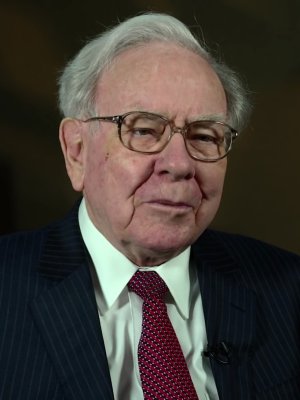
Warren Buffett

Chairman and chief executive of Berkshire Hathaway, 1970–2025

Recorded said elsewhere, not written here
Charlie and I decided long ago that in an investment lifetime it's just too hard to make hundreds of smart decisions. That judgment became ever more compelling as Berkshire's capital mushroomed and the universe of investments that could significantly affect our results shrank dramatically. Therefore, we adopted a strategy that required our being smart - and not too smart at that - only a very few times. Indeed, we'll now settle for one good idea a year. (Charlie says it's my turn.)

His letter to Berkshire Hathaway shareholders in the 1993 annual report, Berkshire Hathaway Inc., February 1994 source ↗

Others on this question

View all 30 →
Chuck Jones Animator, cartoon director and screenwriter
I’m still astonished that somebody would offer me a job and pay me to do what I wanted to do. And to this day, that’s been the astonishment of my life, and delight of my life, and the wonder of my life, and the puzzlement that anybody would be so stupid as to be willing to do that. I hear all these success stories of people, these captains of industry, these forgers of the world, and empire builders and so on. And they talk about all the money they’ve made and become presidents and all that, and I thought, jeez, but look at me. When I was offered a chance to be head of studios I wouldn’t take it. I like to work with the tools of my trade. The tools of my trade is a lot of paper and a pencil, and that’s all it is.
Recorded Academy of Achievement (achievement.org) source ↗
Werner Herzog Film director, screenwriter and opera director
It’s how we are made as homo sapiens. We are biologically organized to cover distances on foot. That’s what we did for tens of thousands of years until we started to use horses, of course, until the mechanical age. And I would not call it “walking” because it’s not going out for a stroll or going out for a “power walk” or ambling in your city. It’s “traveling on foot.” You are reading the world, learning the essence of the world.
Recorded National Geographic, National Geographic, interview conducted via Zoom, 1 January 2020 source ↗
Alice Waters Chef, restaurateur and food activist
There’s no such thing as cheap food. It can be affordable, but it can never be cheap. I think that’s something we’ve been indoctrinated by fast food culture to believe, that it can be cheap – that it can be fast, cheap, and easy. But every culture since the beginning of time has thought of food as something precious, and that’s the way I think about it. I want to give my money to the people who take care of the land, and who grow that food.
Recorded Earth Island Journal, Earth Island Journal interview, 1 January 2015 source ↗
Oliver Sacks Neurologist and writer
I’ve had this concern all the time, but I can only hope that if one writes with appreciation and delicacy and respect, then it’s okay. I have to say that I’ve written a hundred times as much as I’ve published, because if there’s any thought of offense or embarrassment, then I will put the thing quietly away.
Recorded Academy of Achievement recorded interview, American Academy of Achievement, 17 June 2000 source ↗

More from Warren Buffett

View profile →
Question In the last five years, what have you become better at saying no to? Daily life
Yeah and we get calls all the time, and there's so many calls, but the like I said, it takes me five seconds to say no. It takes, Greg's a little more polite than I am, but I just as soon get the calls just to see what people are doing. But they aren't offering anything that's at an attractive price, and what they want is a trade.
Recorded Becky Quick, CNBC “Squawk Box”, recorded in Omaha; CNBC's own transcript of its own broadcast, 31 March 2026 source ↗
Question What is one of the best investments you have made — of money, time, or energy? Money & investment
We've just passed a milestone: Twenty years ago, on January 3, 1972, Blue Chip Stamps (then an affiliate of Berkshire and later merged into it) bought control of See's Candy Shops, a West Coast manufacturer and retailer of boxed-chocolates. The nominal price that the sellers were asking - calculated on the 100% ownership we ultimately attained - was $40 million. But the company had $10 million of excess cash, and therefore the true offering price was $30 million. Charlie and I, not yet fully appreciative of the value of an economic franchise, looked at the company's mere $7 million of tangible net worth and said $25 million was as high as we would go (and we meant it). Fortunately, the sellers accepted our offer. The sales of trading stamps by Blue Chip thereafter declined from $102.5 million in 1972 to $1.2 million in 1991. But See's candy sales in the same period increased from $29 million to $196 million. Moreover, profits at See's grew even faster than sales, from $4.2 million pre-tax in 1972 to $42.4 million last year.
Recorded His letter to Berkshire Hathaway shareholders in the 1991 annual report, Berkshire Hathaway Inc., February 1992 source ↗
Question What does everyone in your world seem to agree on that you think is wrong? Values & belief
The strategy we've adopted precludes our following standard diversification dogma. Many pundits would therefore say the strategy must be riskier than that employed by more conventional investors. We disagree. We believe that a policy of portfolio concentration may well decrease risk if it raises, as it should, both the intensity with which an investor thinks about a business and the comfort-level he must feel with its economic characteristics before buying into it.
Recorded His letter to Berkshire Hathaway shareholders in the 1993 annual report, Berkshire Hathaway Inc., February 1994 source ↗
Question What does happiness look like for you when life is going well? Identity & self
The reaction of my family and me to our extraordinary good fortune is not guilt, but rather gratitude. Were we to use more than 1% of my claim checks on ourselves, neither our happiness nor our well-being would be enhanced. In contrast, that remaining 99% can have a huge effect on the health and welfare of others.
Recorded His own pledge letter, written on joining the Giving Pledge in 2010, The Giving Pledge, 2010 source ↗

More on values & belief

Also answered this

Derek Sivers, Charlie Munger, Yvon Chouinard, Halla Tómasdóttir, Ricardo Semler, Steve Jobs

Search the directory for somebody in particular.

Explore further

Report this answer