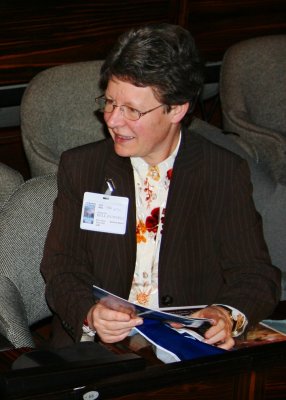
Jocelyn Bell Burnell

Radio astronomer; discoverer of pulsars

Recorded said elsewhere, not written here
Yes, in 2018, I was awarded the Breakthrough Prize for the discovery. I was a bit dumbstruck, never expecting that kind of thing to happen. I was keen that the money should be used well and the best way to do that seemed to be to encourage a more diverse research student population from under-represented groups.

Louise Walsh, University of Cambridge 'Journeys of Discovery' interview series, 1 January 2020 source ↗

Others on this question

View all 50 →
Richard Feynman Theoretical physicist; Nobel laureate in Physics, 1965
So I find that teaching and the students keep life going, and I would never accept any position in which somebody has invented a happy solution for me where I don’t have to teach.  Never.
Recorded Excerpt from “Surely You’re Joking, Mr. Feynman”, Engineering and Science / Caltech Magazine, 1985 source ↗
Bill Clinton 42nd President of the United States, 1993–2001
My job was basically to be a delivery boy for all kinds of things, but they also — because I was at Georgetown and studying international affairs, I was assigned to read six newspapers a day and clip the most relevant articles. This is the technology we used. You couldn’t scan articles. There was no “online.” There was nothing, right? So I would read the newspapers, clip the articles I thought they ought to read, put them on a routing slip, which had on it the names of the senior staff of the committee and all the senators who were committee members. And I would send it to the senior staff, and they would decide whether to send any of them on, but I don’t think I’d have won a Rhodes Scholarship if I hadn’t been a clerk on the Foreign Relations Committee. Nobody else I was competing with read six newspapers a day, and they actually paid me good money to read The Washington Post, The New York Times, The Washington Star, which existed then, The Baltimore Sun , The St. Louis Post Dispatch , and then we alternated — and — oh, and The Wall Street Journal . We read them every day. Those were the six papers we read. I did, and then that’s what the senators got.
Recorded Academy of Achievement interview source ↗
Brian Chesky Co-founder and chief executive of Airbnb
We need to have mentors. I think I've always been pretty shameless about seeking out people much smarter and much more experienced than me from the very beginning. Michael Seibel and other people. And the more successful I got, the more leaders I started seeking out, whether it was investors, or Sheryl Sandberg at Facebook, or I got the opportunity to spend time with Warren Buffett and he became a close mentor of mine.
Recorded Fortune interview, 27 March 2017 source ↗
Aaron Ciechanover Biologist and physician; Nobel laureate in chemistry for the discovery of ubiquitin-mediated protein degradation
Diversifying means going abroad…Be in another culture, speak a different language, see how other people think. Leave and then come back.
Recorded Charmaine Lim, Bah Yirou and Damien Chua, Interview, Nanyang Technological University Institute of Advanced Studies, 26 August 2025 source ↗

More from Jocelyn Bell Burnell

View profile →
Question How has a failure, or apparent failure, set you up for later success? Do you have a favourite failure? Failure & regret
My contemporaries were more upset about the Nobel than I was not to be recognised. One of them labelled it the 'No-Bell' prize! But it was fine by me. There's no Nobel Prize in astronomy and I was really proud that it was my stars that had convinced the prize committee that there was good physics in astrophysics.
Recorded Louise Walsh, University of Cambridge 'Journeys of Discovery' interview series, 1 January 2020 source ↗
Question What is the thing you are best at that nobody watching can see? Craft & work
I was very, very thorough, making sure I really understood how that telescope worked, and that it was working properly. I was quite convinced that I wasn't clever enough to be in Cambridge and would be thrown out at some stage. My policy was to work as hard as I could so that I'd know I'd done my best. We now label this as impostor syndrome, but we didn't recognise, and certainly didn't name it, back then.
Recorded Louise Walsh, University of Cambridge 'Journeys of Discovery' interview series, 1 January 2020 source ↗
Question What is the part of your job that people would be surprised is most of your job? Craft & work
It looked like an agricultural frame, something you might grow peas up – a lot of wires and cables strung from posts over a space the size of 57 tennis courts. It was actually built to study radio emission from quasars. I built the prototype and then six of us took two years to build the real thing.
Recorded Louise Walsh, University of Cambridge 'Journeys of Discovery' interview series, 1 January 2020 source ↗
Question What is the biggest obstacle you have faced professionally? Craft & work
Tony was cautious. He suspected I’d wired the radio telescope up wrong. So we checked on another radio telescope on the site. The thing was pulsing nicely on mine but as we stood by the pen recorder of this other telescope, nothing happened. It was a horrible moment. And suddenly there it was, five minutes later because we had miscalculated when the telescope would see it. If we’d miscalculated by 25 minutes, we’d have all gone home and the story would be different.
Recorded Louise Walsh, University of Cambridge 'Journeys of Discovery' interview series, 1 January 2020 source ↗

More on money & investment

Also answered this

Ahmed Zewail, Aaron Ciechanover, Daniel Kahneman, Elizabeth Iro, Emmanuelle Charpentier, Richard Feynman

Search the directory for somebody in particular.

Explore further

Report this answer